

Hooked #14
Virtual Christmas Parties; how to track your Return on Event Investment (REI); and a GGBU (the great, good, bad and ugly) review of Event Tech Live.

The holidays party season is starting with a bang! I’ve been getting invitations left, right and centre, which is lovely, as this time of the year is such a great opportunity to get together, discuss the future and build stronger relationships in a festive environment. However, there were two particular invites, that surprised me, and even had to read twice - it was for a VIRTUAL Christmas party! “Wait, what?! This is not 2020!”. Can you tell I have a strong opinion on virtual Christmas parties? I’ll tell you all about it below.
I’m also sending this newsletter a day later than usual, as I’ve spent the past two days at Event Tech Live, where I spoke yesterday about personalisation at events — and how a good personalisation strategy can help you improve your Return on Event Investment.
As part of that talk, I shared my scoring model for defining and calculating Return on Event Investment — a data-backed approach that helps you have clearer, more confident conversations with your leadership team when it comes to justifying changes, improvements, and budget allocations.
Continue reading below to learn how it all works and to download your own Return on Event Investment calculator template.
And since I was at Event Tech Live, this week’s GGBU event review will be all about that experience.

Ana Williams
Founder and Event & Marketing Strategist
Building Connections With Purpose
Can a Virtual Christmas Party Substitute an In-Person Party?
This year I already got not one, but two invitations to a virtual Christmas Party! You heard it - virtual! That made a lot of sense during the Covid lockdown, because… that was the only type of party we could do. But in 2025?!
OK, I think I get it. They have a wide number of contacts to invite who live in a variety of locations and want to be inclusive to all. But is a virtual Christmas party going to make it more likely everyone will attend? Especially with a group that has been virtual most of the year and that still has London as its main hub?
Let’s think about this:
Why do companies host Christmas parties in the first place?
To build relationships between employees, clients, and partners
To bring people together in a relaxed environment
To thank those who’ve supported the business through the year
And what do these parties normally involve?
A few drinks. Some food. A bit of dancing. A speech or two.
Maybe a slightly awkward moment between “John from Sales” and “Fiona from Accounts” that everyone pretends they didn’t notice.
But you get it — it’s about connection.
People relax, chat about things outside of work, and form stronger relationships (sometimes even marriages — though that’s not quite the KPI we’re tracking here!).
Now, compare that to a virtual Christmas party — we’ve all been there:
The execs kick it off with a speech.
There’s a presentation, a few awards, some emojis in the chat.
A virtual game or breakout room or two, then a magician or singer in another “room.”
And before you know it, your partner’s home, the dinner’s on, and the Zoom window’s still open in the background.
So let’s be honest, most of the reasons we have Christmas parties aren’t really achieved in a virtual format. The connection, the laughter, the spontaneity, the fun… simply don’t translate through a screen.
If you still want to host something virtual — whether for budget, inclusivity, or remote-team reasons — go for it. But just don’t call it a Christmas party.
Call it a Virtual Awards Ceremony, a Festive All Hands, or a Year-End Gathering — something that reflects what it is, not what it’s trying (and failing) to be.
Basically, when you name an event the wrong way, you set the wrong expectations. It’s all about phrasing and perception. Call it something different and the expectations can align a lot better with your intention for that event.
Are you looking for ideas on how to create more meaningful connections at your events? Book an exploratory call with The Hook Studio today.
Event Strategy That Drives Results
Defining Your Return on Event Investment Score
At The Hook Studio, we define Return on Event Investment (REI) as the measure of success across all the key stakeholders that make an event possible:
Organisers
Delegates
Sponsors (when applicable)
Even if sponsors aren’t involved, organisers and delegates always are — and both matter equally.
Because one thing you have to keep in mind is that even if your event looks great on paper from your perspective (you hit lead targets or revenue goals), but sponsors didn’t see value, they won’t come back next year.
And if delegates didn’t think it was worth their time, they won’t either.
So yes, the event may have achieved a positive ROI this time — but it doesn’t have a sustainable REI for the future.
👉 Real event success isn’t about whether it worked once. It’s about whether it created enough value for every key stakeholder to want to do it again.
Here’s how you can define the Return on Event Investment for your events:
Step 1: Define Success for Each Stakeholder
Start by identifying the goals for each group — your own, your delegates’, and your sponsors’.
Then plan how you’ll measure progress towards each one before the event takes place.
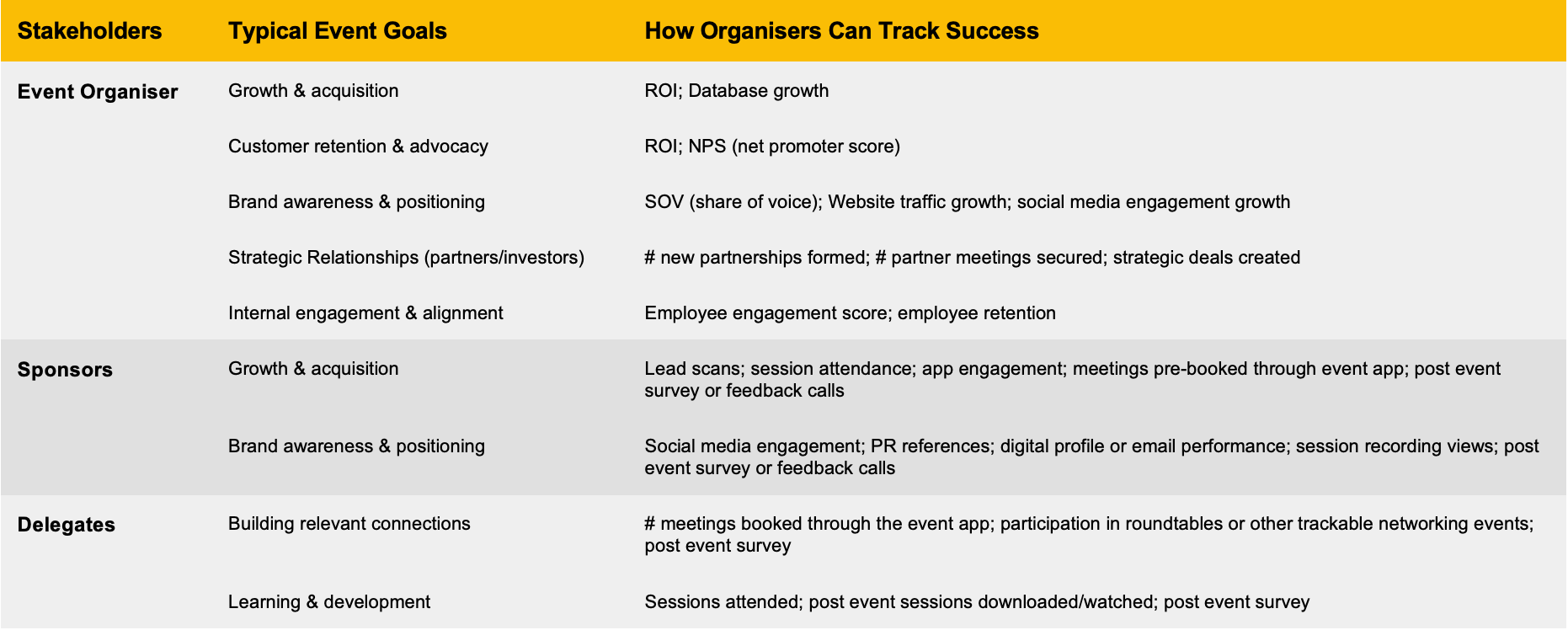
Here are just some examples of typical event goals by stakeholder and metrics you could choose to help you track towards your goal’s success 👇
Step 2: Connect Goals to Measurable Data
The key here is alignment with your leadership team. Make sure you are all in agreement on the event goals that will determine its success, and work together to define the metrics you’ll track to measure that success. This will look different for every company, and there’s no single right or wrong answer — but once you’ve aligned on the goals and metrics, you can put clear measurements in place to ensure that, by the end of the event, you’ve collected the data you need to evaluate your performance.
Step 3: Plan Your Measurement in Advance
Once you’ve defined the goals and metrics for each stakeholder, you can identify:
What data you need to collect,
What tools or surveys you’ll use, and
When you’ll gather that information (before, during, and after the event).
💡 Tip: If you’ve hosted this event before, use last year’s data as a benchmark. It gives you a realistic baseline for goal-setting this time around.
Step 4: Calculate Your Return on Event Investment Score
As results come in, compare your targets with actual outcomes.
The difference between your goal and your result gives you a percentage of achievement.
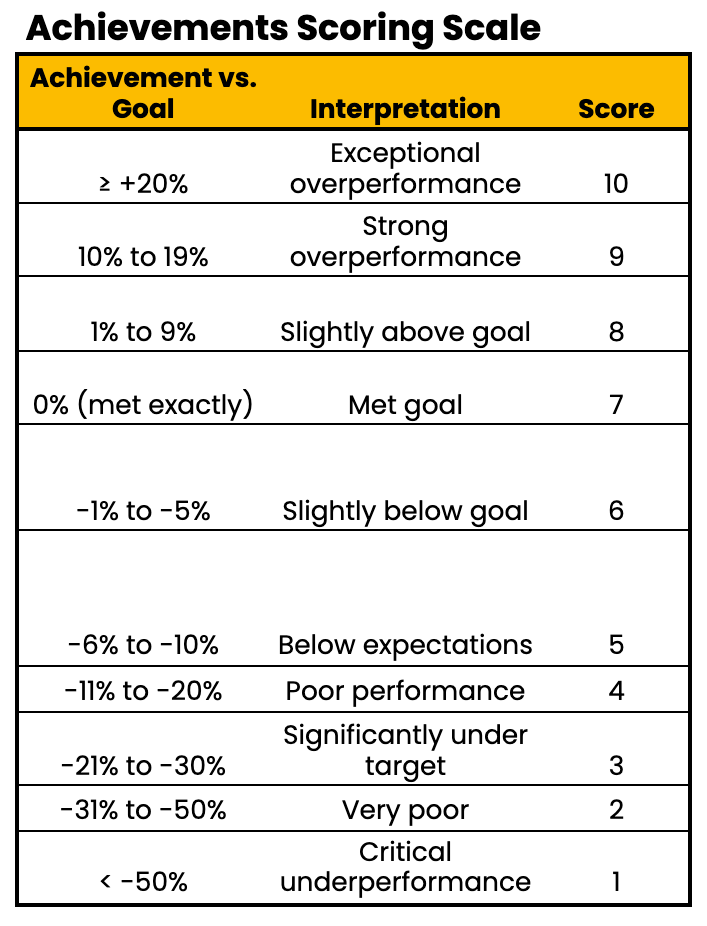
You can then assign each goal a score (1–10) based on a specific scoring scale logic like the one below to help you visualise performance at a glance:
Here’s an example of what that might look like overall for a sample event 👇
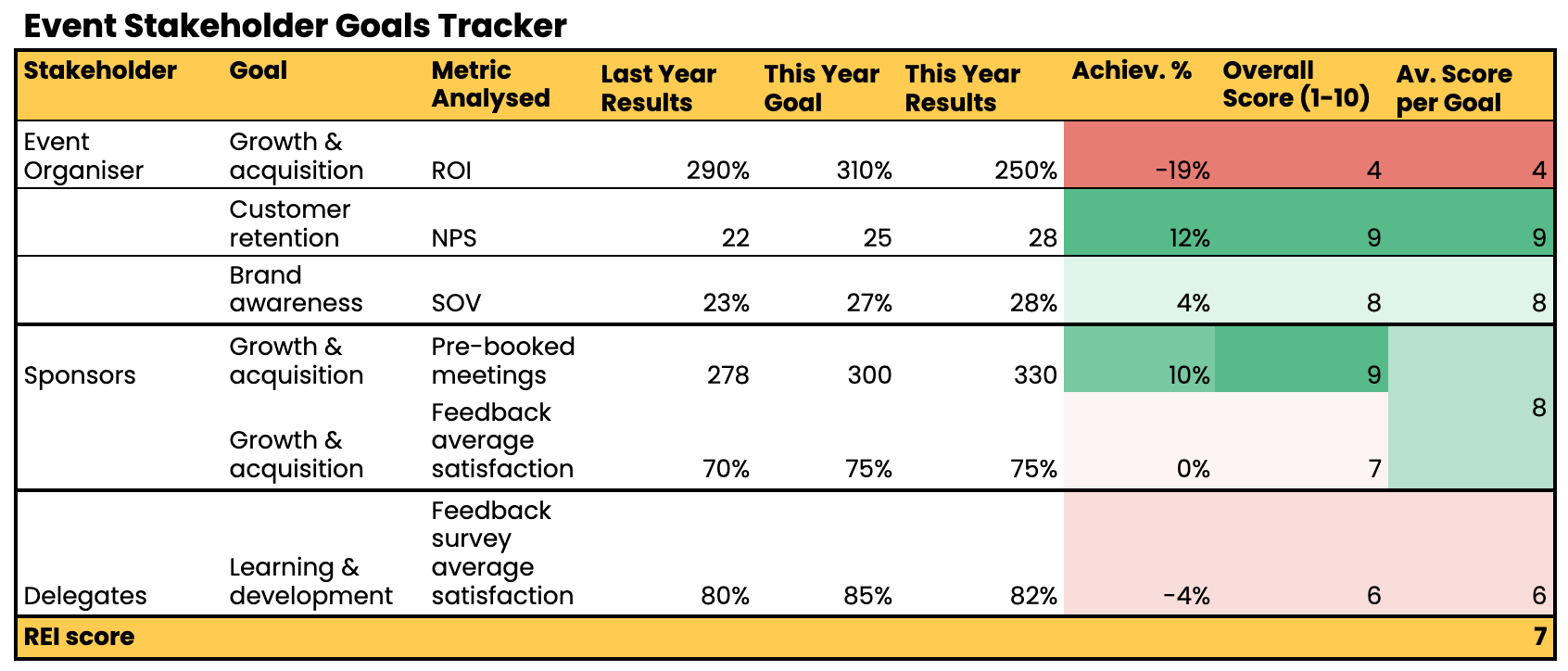
Overall Event Score: 7 → Met Goal
Step 5: Use Your REI to Tell a Stronger Story
This framework gives you the language and data to have clear, confident conversations with your executive team.
It helps you:
✅ Justify your event strategy and budget
✅ Highlight wins beyond just leads or revenue
✅ Show how the event delivered value for everyone — not just the business
When you can measure what truly matters, you’re not just proving your event worked but you’re proving it’s worth doing again.
📊 Download The Hook Studio’s Return on Event Investment template Google sheet to track your own REI score - here
Need help setting up a tracking and analysis system tailored to your events? Book an exploratory call with The Hook Studio today.
The Great, Good, Bad and Ugly (GGBU): Event Review
In this section, we review recent events we’ve attended, highlighting what worked well, what could be improved and what simply didn’t land. We focus on key areas like audience engagement and experience, communication throughout the event lifecycle, content quality, operational execution, and overall brand impact. Follow The Hook Studio’s Instagram for more event highlights and reviews!
Event Tech Live
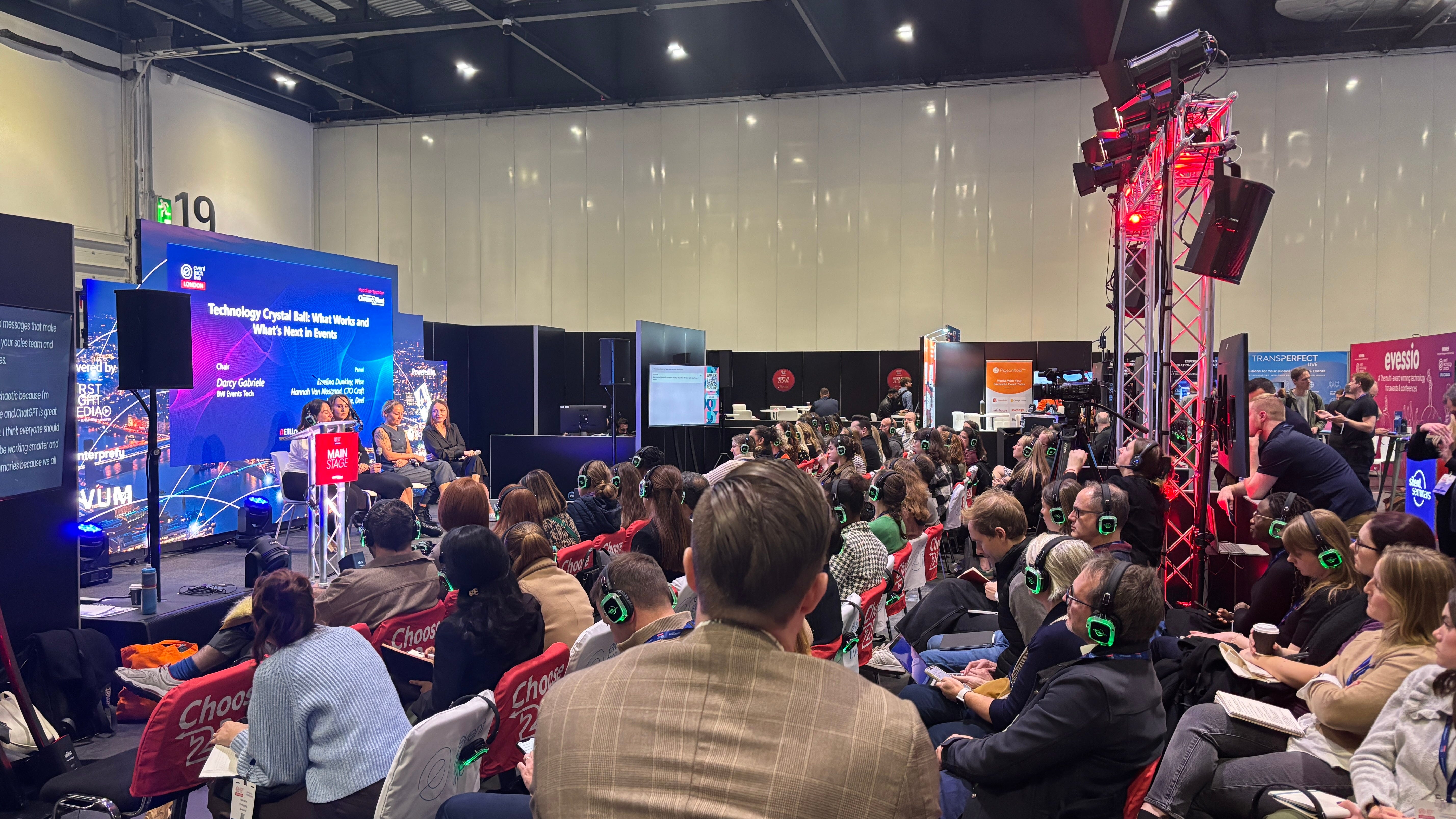
Event Tech Live took place on the 12th and 13th of November at the ExCeL London, bringing together event hosts, organisers, and technology providers to explore the latest innovations in event tech.
From AI tools to engagement apps, content formats, and new networking experiences, the show aims to help organisers rethink how technology can elevate the attendee journey and achieve their overall goals. Follows the review:
The Great:
Very focused theme + strong variety of tech suppliers: The event stayed tightly centred on event technology, and the exhibitor mix reflected that. Delegates could explore a wide range of solutions relevant to actual day-to-day event challenges.
Real-time translation & digital Q&A tools on stage: Sessions included technology that enhanced accessibility and delegate participation, offering a smooth experience for both speakers and attendees.
Tight organisation despite a complex format: For an event with so much happening in a relatively small space — expo floor, content stages, live interviews, podcasts, meetups, braindates, speed networking, awards, plus gamified elements — everything I experienced ran impressively on time.
Event tech live is a good example of an event that is bringing the theme of the event to live by incorporating various event technology into the experience of its own event. It reflects how its a lot more tangible to show people how something is done rather than telling someone how its done, as people get it and remember it better..
The Good:
Gamification as part of the event experience: The gamification activities were visible, encouraged in-app, and reinforced from the main stage. Delegates could take several challenges on site and on the app, could see how they were performing in the leaderboard and got rewards along the way. The downside is that ExCeL’s inconsistent WiFi made it hard for delegates to participate smoothly.
If your engagement strategy relies on tech, always have a connectivity fallback. Otherwise the best experience can become frustrating.
The Bad:
The event app felt overly complex: Delegates kept referencing the complexity of the app. They felt there was too much for them to absorb and therefore they nearly scratched the service of what was possible to do through the app. Too much functionality can overwhelm delegates and reduce adoption.
Inconsistent sponsor booth quality due to shell schemes: Some stands were beautiful and custom-built, others looked plain and uninspired — creating a patchy visual experience across the floor. A cohesive booth approach would have elevated the overall look and feel for both sponsors and delegates.
Simplicity wins. Choose a few high-impact features and make them flawless rather than trying to fit too much and create confusion.
The Ugly:
Nothing in particular stood out but if I had to choose one it has to be the poor wifi connection. We absolutely need strong wifi at events as this seems to be a consistent problem across venues.
Overall these were two well spent days that enabled delegates to have a variety of interactions, experience a lot of the technology on showcase, and make a lot of new contacts. The formalised meetups and braindates (roundtable discussions) were incredibly helpful to bring people together, that they may have found difficult otherwise simply through the app networking tool. And hats off to the organisers for showcasing so much of what it’s possible to do with event technology at their own event.
What Else is On My Mind?
IBTM - One of the largest conferences for the MICE industry is taking place in Barcelona next week, and I’ll be there. If you are planning to be too, drop me a note.
Global Event Tech Summit - I’ll be speaking on a panel discussion alongside Vanessa Lovatt from Event Tech World, Tommy Moore from DRPG and Zoe Lacey-Cooper from Alternative Events pm the topic of ‘Personalisation that Connects: Making Experiences Feel More for One"‘. If you are planning to be there, drop me a note so we can meet.
Did you enjoy this Hooked newsletter? Have any topics in mind you’d like us to write about? Drop us a note with your thoughts.
How Can You Support this Substack?
The Hooked Substack is free but you can support it by subscribing and sharing the link with any business owners, marketers, GTM leaders, event professionals or others who may benefit from improving their event strategy to drive more authentic connections and business growth.